 Vaeleen Digital
If you have scrolled through the automotive side of YouTube recently, you might have come across a viral series by former racing driver Mark McCann. He took on the seemingly impossible challenge of restoring a legendary, £900,000 Bugatti Veyron that had been sitting split completely in half for four years. The car seemed destined for the scrapyard, until two British engineers stepped in and saved it using knowledge and software code they had written two decades ago.
One of those engineers is Andrew Smith. But before Mr Smith was saving hypercars on the internet, he was standing right here in our Sixth Form Centre, engaging in a lively, professional debate with me during the EPQ evening on the philosophy of "Driver vs. Car" in Formula 1. While I was passionately defending the raw, human skill required by Formula 1 drivers, Andrew was backing the machine. And he had every right to! Early in his career, Andrew was tasked with what many consider a "Concorde moment" in automotive history: writing the low-level software and control systems for the Veyron’s mind-boggling 1,001-horsepower transmission.
After seeing him pop up on YouTube, I took a chance and reached out to Andrew on LinkedIn to say how brilliant it was to see him working on the car. To my absolute delight, he offered to come back to Bablake for a one-on-one chat. We sat down to catch up on the Veyron, talk about the reality of big engineering budgets, and map out some advice for navigating the jump from A-Levels to the real world.
Production Vehicle 6.75, assembled.
Scroll to rebuild the car, layer by layer, in the order the drivetrain came back to life.
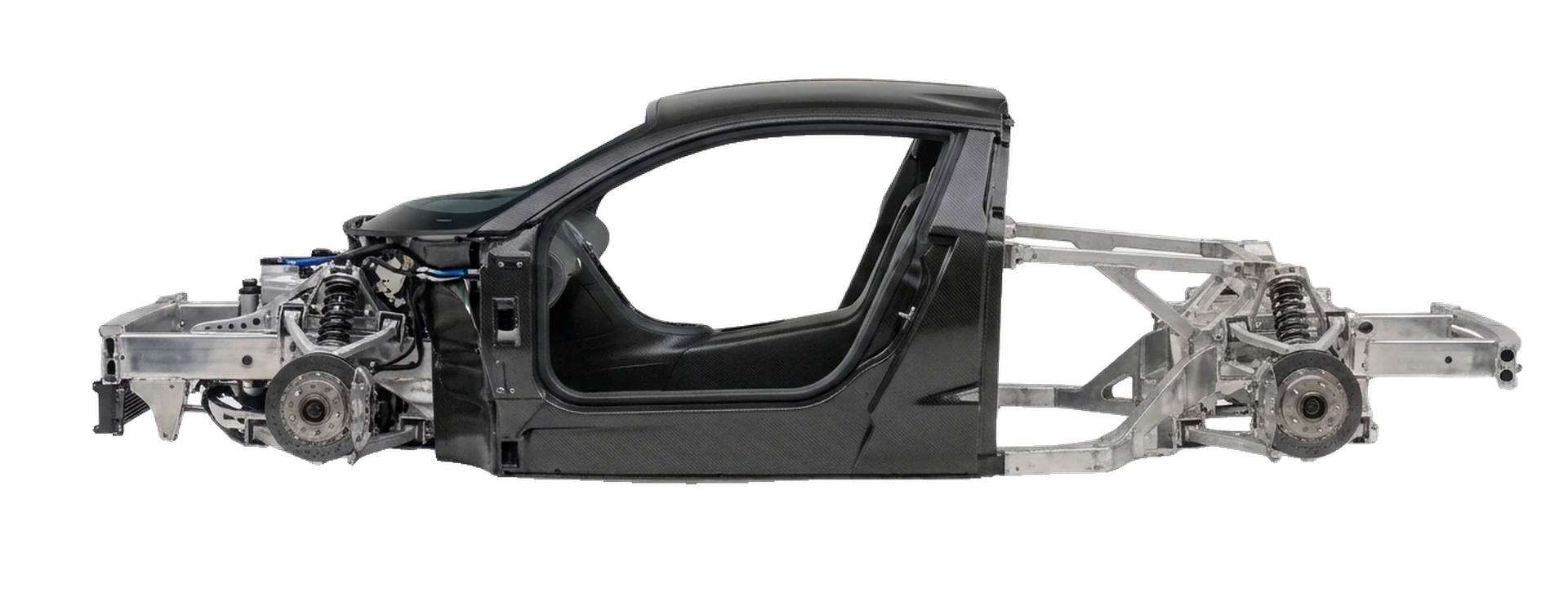
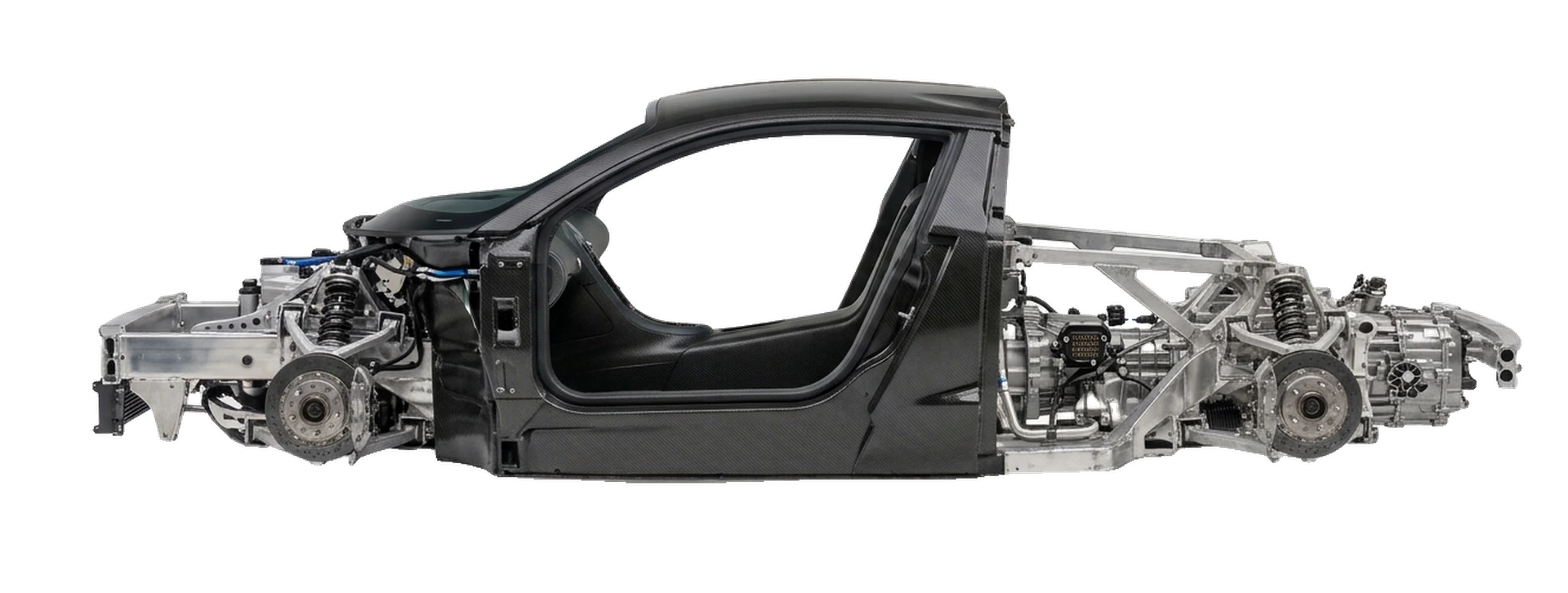
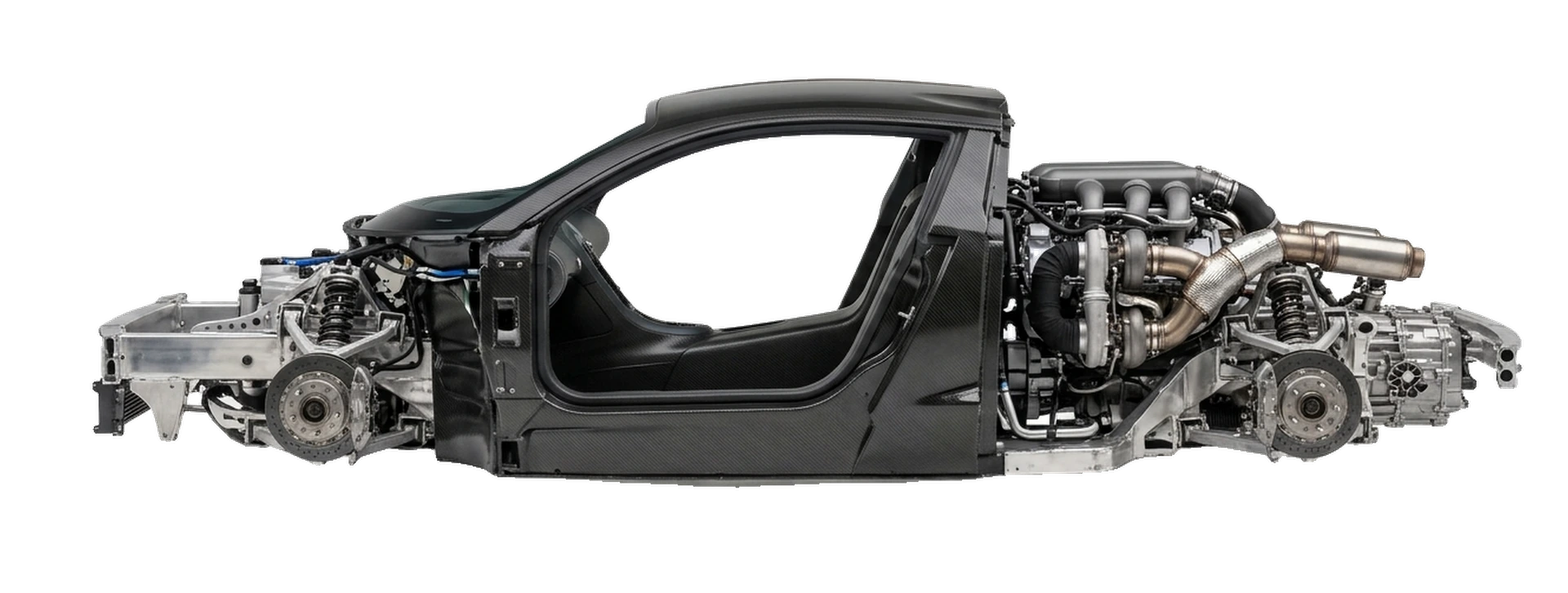



Illustrative, AI-assisted representation in the style of Production Vehicle 6.75. Not a photograph of the actual car.
- 01MonocoqueThe bare carbon-fibre monocoque with its front and rear subframes. Everything else bolts to this.
- 02GearboxThe 7-speed dual-clutch transmission goes onto the rear mount.
- 03EngineThe W16 and its quad-turbo assembly drop into the rear frame and meet the gearbox.
- 04BodyworkExposed carbon-fibre and polished aluminium panels wrap around the frame.
- 05InteriorThe door opens on the leather and carbon cabin.
- 06WheelsThe door closes, the wheels go on, and the build is complete.
The Real Story Behind YouTube’s Biggest Rebuild
"We weren't actually called over by Mark,” Andrew smiled as we talked about how he ended up on Mark McCann's channel. It turned out his long-time engineering partner, Rob, simply followed McCann on YouTube.
During our chat, Andrew showed me two incredible photos of himself standing next to Bugatti’s Prototype Car 1.1, a vehicle owned by Volkswagen that was used throughout the entire original engineering prototype phase. The first photo was captured in Upington, South Africa, back in 2003, and the second was taken more recently at the Louwman Museum in The Hague in August 2026. For Andrew, being reunited with Prototype 1.1 felt just like "seeing an old friend again."
However, that exact same nostalgic feeling applied when they got involved with Mark McCann's actual car. Mark’s car is a unique beast: Production Vehicle 6.75, originally owned by a resident of Dubai and heavily customised by the Mansory company in Germany. When Rob saw the video of Vehicle 6.75 split in half, he and Andrew instantly knew what was wrong just by watching the footage. The car had been sitting in two halves with no gearbox for nearly two years. Horrified to see it in pieces when they knew exactly what the issue was, they decided to reach out and step in.
What followed was a masterclass in international collaboration and teamwork. Their rescue mission began by traveling over to the Netherlands to work with Pascal at KMP Drivetrain Solutions, who had been painstakingly reverse-engineering the custom clutch plates from scratch because Bugatti wouldn’t sell the separate components. Working alongside Pascal's team to map out the mechanical state of the unit, they were able to get the gearbox ready to ship back to the UK. From there, the transmission went straight to Revotech to be wired up to a specialist test rig so they could safely run and calibrate the unit.
Andrew emphasised that this testing work at Revotech relied entirely on modern transmission controllers and new software developed by his team at Elsense. They had no physical sight of the original software code they wrote all those years ago. Instead, they had to rely on pure memory, recalling exactly how the intricate system was originally put together and controlled. Because they had engineered the system back then, they remembered enough to successfully apply their modern software to it, dial in the correct clutch signals, and bring the hypercar's transmission back to life.
The Legend of the £3 Million Loss
One of the most famous facts about the Bugatti Veyron is that Volkswagen allegedly lost a fortune on every single one they sold. Andrew confirmed the jaw-dropping numbers: each car cost roughly £4 million to manufacture, meaning Bugatti lost about £3 million per car.
However, Andrew cleared up a major misconception. This wasn't a chaotic, runaway budget mistake; it was actually a highly calculated corporate marketing masterstroke. Volkswagen engineered the Veyron in parallel with the VW XL1, an ultra-lightweight, aerodynamic diesel-hybrid car with distinctive wheel covers capable of an astonishing, official 261 miles per gallon. By building both side-by-side back in 2005, a full decade before mainstream ICE/eV hybrids became widely available, VW was flexing its muscles to the world. They proved they could master the absolute extreme of fuel efficiency on one end, and the pinnacle of luxury and speed on the other. It was the ultimate marketing exercise to show the world that Volkswagen could do absolutely anything.
Balancing Budgets and Innovation
When asked how much financial budgets limit creative innovation, Andrew shared a valuable perspective on business strategy. He noted that smaller firms are often in a fortunate position where they can adapt quickly and invest directly in the exact tools they need. In that environment, budgeting becomes less about strict limitations and more about making smart, high-level business decisions to drive the company forward efficiently. He pointed out that smaller firms don’t face the same heavy budget friction as massive corporations. In those larger global companies, the ultimate direction and creative freedom often depend heavily on who is running the ship, specifically, whether the leadership style leans toward an engineering mindset or a purely financial head.
Strategy for the Future: Uni vs. Apprenticeships
As a Year 13 student currently studying Maths, Physics, and Business, I wanted to pick Andrew’s brain on how the landscape has shifted since he completed his Master's degree.
For students weighing up options today, Andrew is a cautious fan of the modern Degree Apprenticeship route, provided you find the right company and sector that works for your goals. "If you can find a degree apprenticeship with the right company... then that works," he advised. He emphasised that it is a highly viable route, but you must ensure you truly like the company environment. He did offer one smart piece of warning, though: always read the fine print regarding "tie-ins" that might lock you into staying with a company.
For someone like me aiming for the finance and commercial side of tech, Andrew offered up some valuable insights. His advice was to be proactive: if the organisation is large enough, you can specifically request to be rotated into the corporate and financial wings you want to experience.
The Academic Leap from A-Levels
And what about the academic leap from A-Levels to Higher Education? Andrew didn't sugarcoat it, noting that the mathematical step-up depends heavily on your degree. In rigorous technical fields like engineering, the maths is undeniably wider, harder, and more abstract. However, his perspective on real-world logic was incredibly reassuring. He explained that university and industry work aren't about learning completely unrecognisable concepts; rather, you are using the same fundamental concepts to solve new problems. He assured me that everything you learn at A-Level ends up being incredibly handy. His ultimate advice to me was to thoroughly check the specific course modules of university choices, such as Warwick or Birmingham, and directly ask the faculty detailed questions to make sure the syllabus aligns perfectly with my long-term goals.
Stepping away from the interview, it was clear that whether you are writing code for a 250mph hypercar or navigating the business world, success comes down to understanding the logic and data underneath.
My massive thanks to Mr Smith for returning to Bablake and offering an unforgettable glimpse behind the curtain of automotive history.